Token Governance for AI Agents: What McKinsey’s New AI Economics Research Means for Runtime Cost Control
By Skyrelis ·
Why agent token bills surprise everyone
A chatbot spends tokens when a person types. An agent spends tokens whenever it decides to: every plan, tool call, retry, and handoff to another agent is another model request, often carrying the whole conversation and tool output along with it.
That is why teams that budgeted for chat are often caught off guard once agents reach production. The cost driver is no longer how many users you have. It is how your agents behave, and that behavior changes with every prompt edit, new tool, or model swap.
Token governance means treating spend the way you treat access: visible, attributed to an owner, bounded by policy, and enforced at runtime, not reconciled on next month’s invoice.
The numbers behind the bill
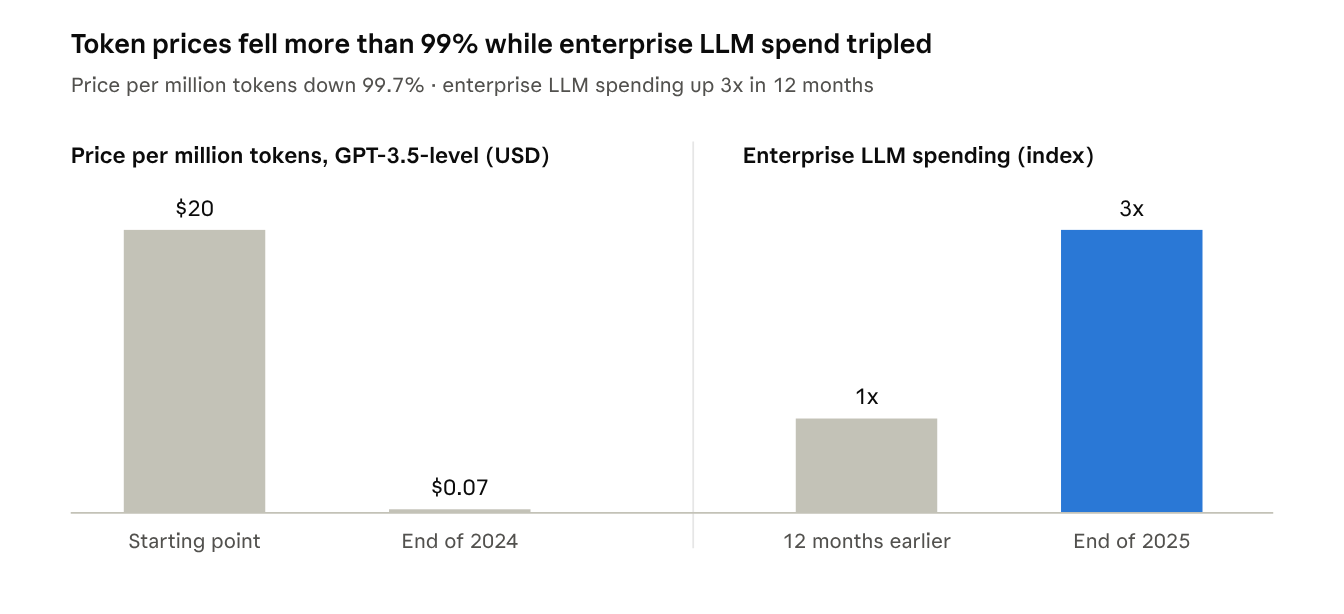
Token prices have collapsed, yet enterprise AI bills keep climbing. McKinsey’s Q4 2026 Quarterly, which devotes its cover package to the economics of AI, puts figures on the gap:
- Prices fell; spending rose. Inference for GPT-3.5-level capability dropped from $20 to $0.07 per million tokens through 2024 (Stanford HAI), but enterprise LLM spending tripled in the 12 months to the end of 2025.
- Budgets are breaking. 93 percent of organizations McKinsey surveyed say they have exceeded their AI budgets. In McKinsey’s separate global state of AI survey, one in five say they have constrained AI use because of operating costs.
- Scale multiplies spend. Moving from isolated use cases to enterprise-wide adoption raises AI spend nearly fourfold, and most firms expect spend to grow at least 25 percent in the next 12 months.
- Much of it is invisible. McKinsey estimates 20 to 30 percent of AI spend is often unaccounted for, scattered across vendors and tools, and only 20 to 25 percent of companies have mature AI FinOps practices.
McKinsey’s conclusion matches the premise of this post: the goal is not the lowest token count but the best return per dollar, governed per task and outcome rather than per invoice.
Header chart: McKinsey Quarterly Q4 2026, citing Stanford HAI 2025 AI Index (price) and enterprise LLM spending trend to end of 2025.
Where agent token costs actually come from
Most agent spend comes from a few repeating patterns, not from the user’s original question.
| Cost driver | What happens | Why it grows |
|---|---|---|
| Context re-sending | Each step re-sends the full history, system prompt and tool output | Input tokens grow with every step of a task |
| Tool output stuffing | Large API or database responses are pasted into the next prompt | One verbose tool can dominate a request |
| Retries and loops | The agent re-plans after an error, or two agents keep handing work back and forth | Cost has no natural ceiling |
| Model choice | A frontier model handles steps a small model could do | Price per token can differ by 10x or more between tiers |
| Fan-out | One request spawns sub-agents or parallel tool calls | Spend multiplies per user action |
Input tokens usually far outnumber output tokens in agent workloads, because context is re-sent at each step. Watching only the prompt the user sees misses where the money goes.
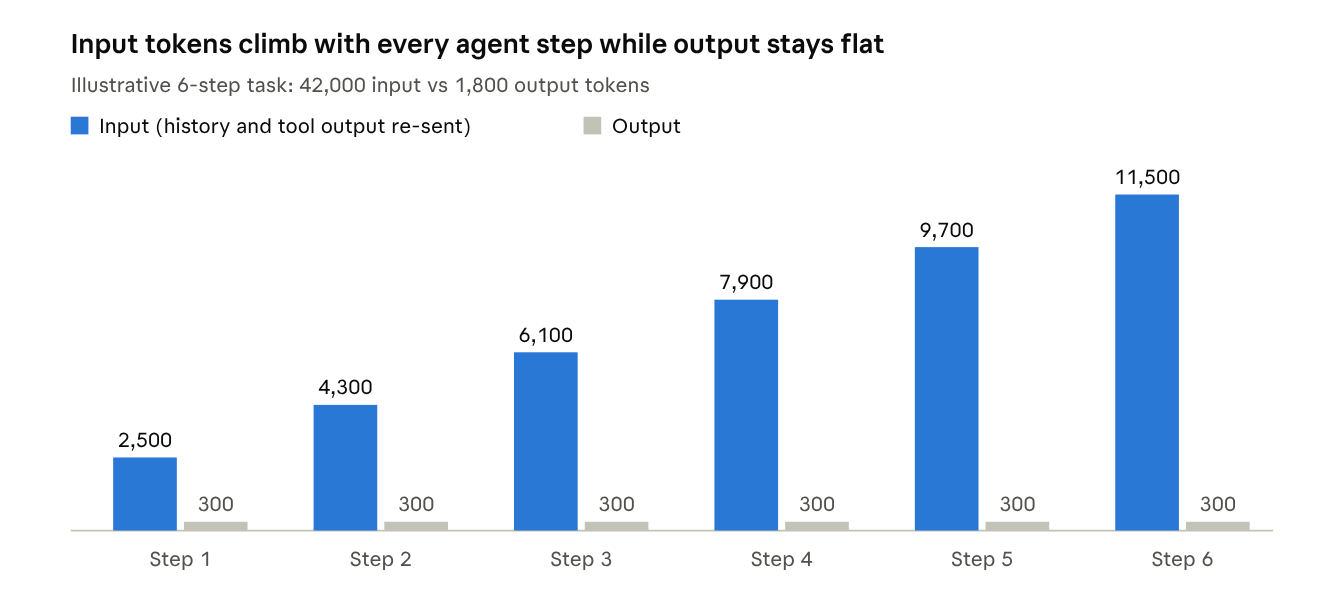
By the last step, each call re-sends more than four times the context of the first, so a longer task costs far more than its step count suggests.
McKinsey’s research puts real numbers on these patterns. Agentic tasks can consume roughly 1,000 times more tokens than single-turn code reasoning or multi-turn chat. About 60 percent of an agentic task’s cost goes to checking, repairing and re-verifying answers, not producing the first one. And the same task can vary in cost by up to a factor of 30 from one run to the next.
Why provider budgets and app-level limits fall short
The controls most teams start with were built for a different problem.
- Provider dashboards show spend per API key or project, not per agent, customer or workflow. You learn who to blame after the bill arrives.
- Provider spend caps are blunt. When the cap trips, every agent on that key stops, including the ones doing important work.
- Limits coded into each app drift apart. Every team writes its own counters, a model swap breaks them, and nobody can answer, “what is our total exposure?”
- Multi-model, multi-provider stacks split the picture across several invoices with different units and pricing.
Variance is the deeper problem. When one run of a task can cost up to 30 times more than another, cost behaves like a distribution, not a unit price, and a budget built on average usage will be wrong. McKinsey also notes that cost overruns typically become visible only after the tokens are spent.
The gap is the same one security teams found with access control: the policy needs to live in one place, apply consistently across every model and framework, and be enforced before the request runs.
A five-step framework for governing token spend
Govern tokens in the same order you would govern access: see it, attribute it, bound it, enforce it, then close the gaps.
- Meter every model request in one place. Record input and output tokens and cost for every call, across every provider and model, in a single unit you can compare. Flag requests that never report final usage, so totals are not silently understated.
- Attribute spend to an owner. Roll usage up a hierarchy that matches how you sell and operate: organization, application, customer, agent. Per-customer attribution is what lets you price, charge back, or spot one tenant driving most of the cost.
- Set budgets and rate limits as policy. Define a monthly budget, a token rate limit and a request rate limit once at the top and let applications and agents inherit them. Override only where a workload genuinely needs more or less.
- Enforce at runtime, before the model runs. A limit that only alerts after the fact is a report. Check each request against its budget and limits before it reaches the model, and block, throttle or escalate when it would exceed them. Start in monitor mode, then turn on blocking once the thresholds are tuned.
- Watch pace and coverage. Compare spend against how much of the period has passed, project the month’s total, and list any application or agent that has no budget or rate limit. An ungoverned agent is the one that produces the surprise bill.
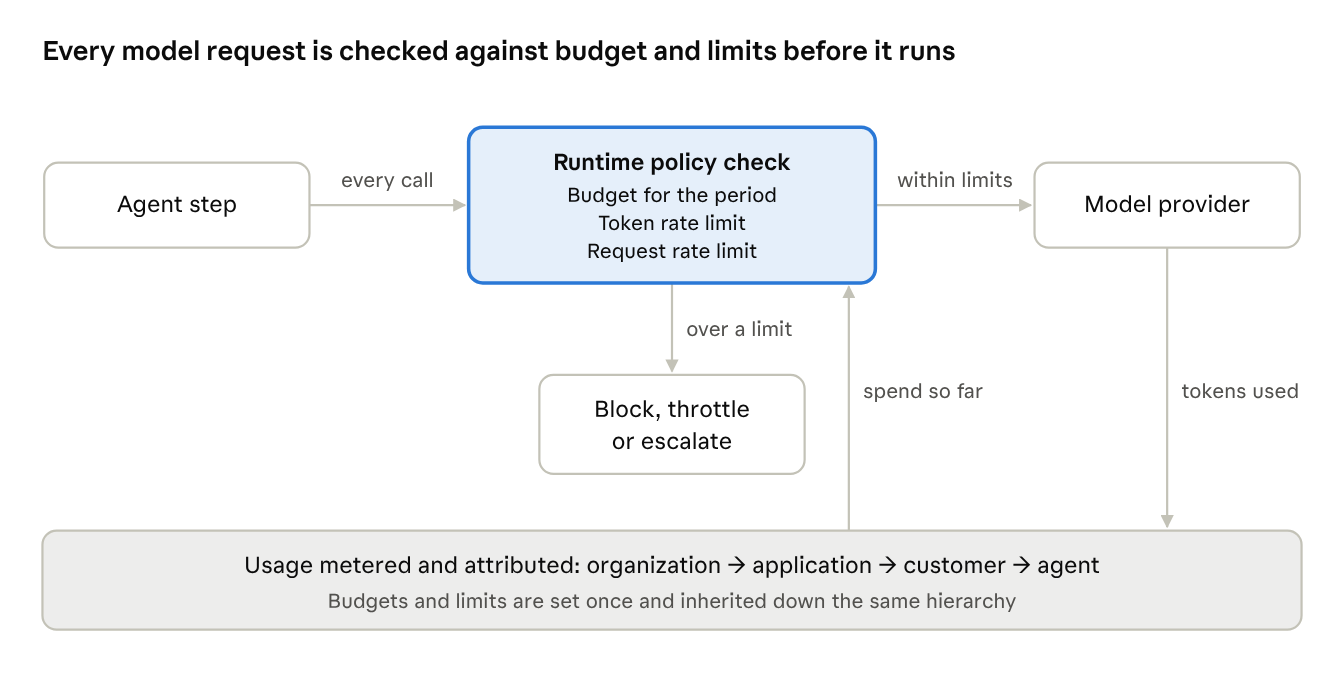
The check happens before the model runs, and every response’s usage feeds back into the next decision.
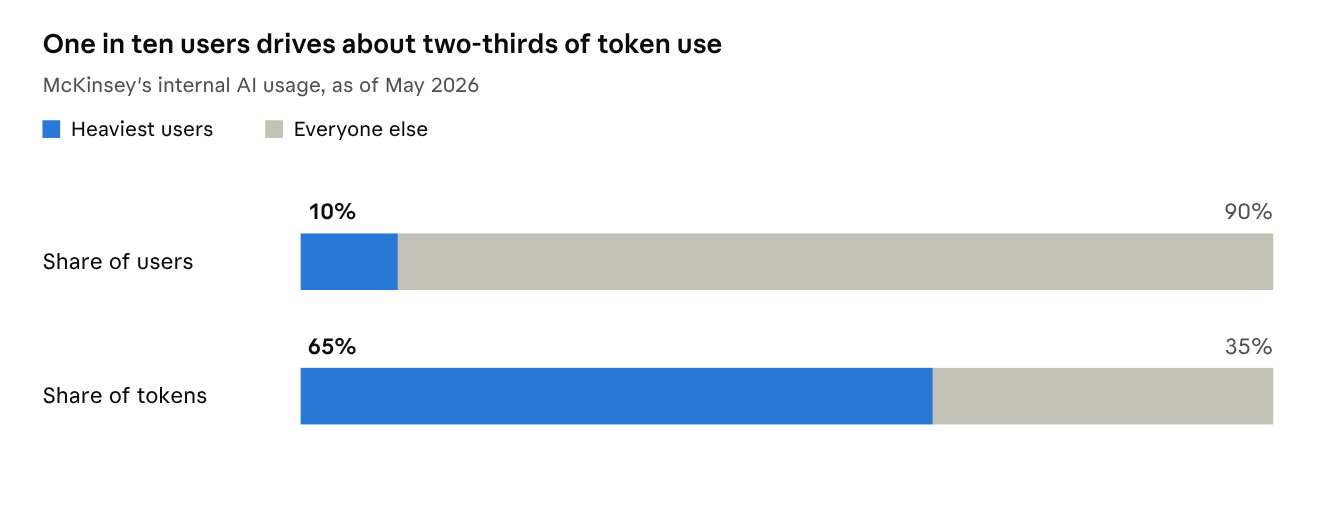
Attribution matters because usage concentrates. Inside McKinsey, roughly 10 percent of users account for about 65 percent of token consumption, and in an agent fleet a few agents, customers or workflows usually drive most of the bill. Per-owner attribution shows where limits matter most.
Cost control is a security control
Runaway token spend is often the first visible symptom of something that is also a security problem.
- Prompt injection can push an agent into repeated tool calls or long generations, turning one malicious input into a large bill.
- Denial of wallet: an attacker, or a buggy client, can drive request volume until budgets are exhausted and legitimate users are cut off.
- Loops and cascading failures between agents look like a cost spike before anyone notices the wrong outcome.
The OWASP Top 10 for Agentic Applications 2026 names tool misuse and cascading failures among the leading agentic risks. The OWASP Top 10 for LLM Applications 2026 also lists unbounded consumption, which covers denial of wallet, as a risk. Rate limits and budgets enforced at runtime do not stop these attacks on their own, but they cap the damage, which is why token policy belongs next to security policy rather than in a finance spreadsheet. Our OWASP Agentic Top 10 chapter maps all ten risks.
How Skyrelis approaches it
Skyrelis is the runtime policy layer for AI agents. Token budgets and rate limits are defined as policy alongside security and compliance rules, inherited down from organization to application to agent, and enforced on each request before it reaches the model, across models, clouds and agent frameworks, without SDKs or code changes.
McKinsey describes this layer as part of an “AI control plane” that enforces token budgets, spend thresholds and other rules in real time, before avoidable spend occurs. Skyrelis provides that runtime enforcement, alongside the security and compliance policies that run on the same requests.
See token governance on your own agents — request a demo
FAQ
What is token governance for AI agents?
Token governance is the practice of metering, attributing, limiting and enforcing model token usage per organization, application, customer and agent, so AI spend is controlled by policy at runtime instead of discovered on the invoice.
Why do AI agents cost more than chatbots?
Agents make many model calls per task. Each step re-sends conversation history and tool output, and retries, loops and sub-agents multiply calls, so input tokens grow far faster than with single-turn chat.
What is the difference between a token budget and a rate limit?
A budget caps total spend or tokens over a period, such as a month. A rate limit caps how fast requests or tokens can be consumed, such as per hour. Budgets prevent overruns; rate limits stop spikes, loops and abuse.
Should token limits block requests or just alert?
Start in monitor mode to learn normal usage, then enforce. Alerts alone arrive after the money is spent; blocking or throttling before the model runs is what actually caps cost.
How do I allocate AI costs to customers?
Attribute every model request to the customer it serves, then roll up tokens and cost per customer. This supports usage-based pricing, chargeback, and spotting tenants whose usage is out of line.
How many companies are going over their AI budgets?
In a McKinsey survey published in its Q4 2026 Quarterly, 93 percent of organizations reported exceeding their AI budgets, even as per-token prices fell sharply.
Sources
- McKinsey Quarterly, Q4 2026, cover package “The New Economics of AI”:
- “Is That AI Agent Worth It? Agentic Economics and the Modern Operating Model” (Hämäläinen, Patel, Blumberg, Catlin, Lala): price vs spend trend, 93% over budget, the 1,000x / 60% / 30x figures, McKinsey’s internal usage lessons
- “The Cost of Intelligence: How to Manage AI Demand at Scale” (Sachdeva, Lala): fourfold spend at scale, 20–30% unaccounted spend, FinOps maturity, the AI control plane
- Stanford HAI, 2025 AI Index (as cited by McKinsey): inference cost decline
- OWASP GenAI Security Project, Top 10 for LLM Applications 2026: unbounded consumption as a listed risk
- OWASP GenAI Security Project, Top 10 for Agentic Applications 2026: tool misuse and cascading failures